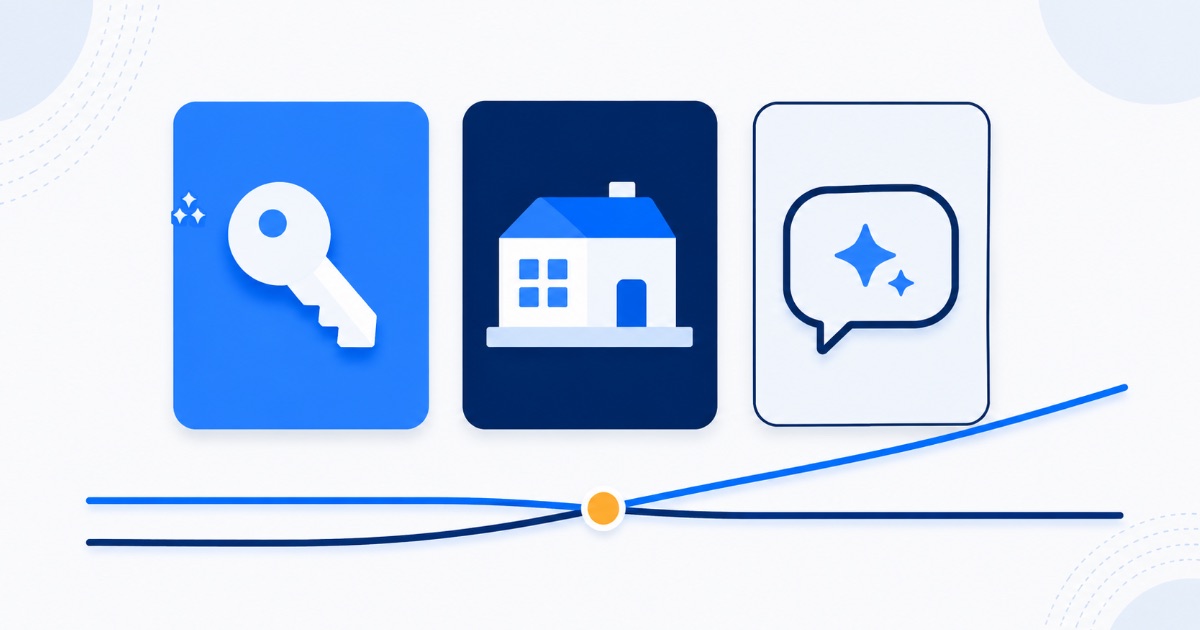
Ads buy attention immediately and stop the moment you stop paying. SEO builds an asset that takes months to appear and keeps working after the invoice ends. AI visibility cannot be bought at all today, because there is no advertising slot inside assistant recommendations, so it is earned or it is absent. Most businesses need a mix, and the correct mix depends on four things: your margin, your sales cycle, your competition, and how long you can wait. Here is the arithmetic that decides it, rather than the usual answer of "it depends".
The fundamental difference: rent, own, earn
- Ads are rent. You pay per click, every click, forever. Stop paying and visibility ends that afternoon. In exchange you get speed, precise targeting, and clean measurement.
- SEO is ownership. You pay for labor once and the resulting page keeps earning, with maintenance rather than rent. In exchange you accept months of delay and no guarantee of position.
- AI visibility is earned reputation. No spending unlocks it, because assistants do not sell placement in their recommendations. It follows from the same work as SEO plus consistent identity and independent mentions, as set out in our SEO versus AEO comparison.
Notice these are different kinds of thing, which is why "which is better" has no answer. Renting a shop, buying a shop, and being recommended by everyone in town are three different questions.
The math that actually decides it
Run this comparison with your own numbers, because industry averages will mislead you:
- Ads: cost per click multiplied by clicks needed per customer equals your cost per acquisition. It stays roughly constant forever, rising as competitors bid more.
- SEO: total investment over twelve months divided by customers acquired in that period equals your cost per acquisition in year one. Then divide the same investment across year two, where the content still ranks and the spending drops to maintenance, and watch the number fall.
The crucial part is that these two numbers move in opposite directions. Ads cost the same on day one and day one thousand. SEO looks catastrophically expensive in month three and unreasonably cheap in month thirty, which is why judging it on a quarterly report guarantees the wrong decision. The timelines in our honest SEO timelines guide tell you where the crossover typically sits.
One more figure worth calculating: what a month of ad spending would buy in content and technical work. For many small businesses, a single month of moderate ad spending funds several months of SEO, which reframes the choice from either-or into sequencing.
When ads clearly win
- You need customers this month. Nothing else in marketing turns on that quickly.
- You are testing a new offer, market, or message. Ads buy fast, clean data about what converts, and that knowledge then makes your SEO content dramatically better.
- Your product is seasonal or time-limited. An event in six weeks cannot wait for organic rankings.
- The organic results are unwinnable for now. If page one is entirely national brands and your domain is new, buy your way into the conversation while you build.
- Your margins are high and your sales cycle is short. Expensive clicks are fine when one customer pays for many of them.
When SEO and AI visibility clearly win
- Your customers research before buying. Long consideration cycles are won by being present throughout, and you cannot afford to rent attention across every step.
- Your margins are thin. When a customer is worth modest money, paying for every single click never stops hurting.
- You are building a business to sell or hold. Organic visibility is an asset that appears in valuations; ad accounts are an expense line.
- Your competitors are outspending you. You cannot win an auction against a bigger budget, but you can absolutely out-publish and out-earn them in organic and AI results.
- Your buyers now ask assistants. This is the newest reason and the least contested: there is no auction to lose, so early effort compounds where money cannot follow.
The measurement trap that skews every comparison
This is the section most articles on this topic omit, and it changes decisions.
Standard analytics attributes conversions to the last click, which systematically flatters ads and undercounts everything that influenced the buyer earlier. A customer who read three of your articles in March, saw you cited in an AI answer in April, then clicked a branded ad in May appears in the report as a pure ad conversion. The ad captured the sale; the organic work created it.
Two specific distortions worth knowing:
- Branded search ads frequently harvest demand created by everything else, taking credit for customers who were already searching your name.
- AI-referred visitors often arrive without referrer data, landing in direct traffic and crediting nobody at all, which is one reason so few businesses realise the channel is working, as noted in our search statistics roundup.
The practical correction is to watch total leads, branded search volume, and direct traffic alongside channel reports, and to pause branded ads occasionally to see what organic recovers on its own. Businesses that run that test are often surprised by how much they were paying for traffic they already had.
The sequence most businesses should follow
- Months 1 to 3: ads for immediate revenue and market data, while technical foundations and the first content are built. Use what ads teach you about converting language to write better organic pages.
- Months 4 to 9: organic begins contributing, ads continue on the highest-intent terms only, and you start measuring AI citations alongside rankings.
- Months 10 and beyond: shift the balance as organic cost per acquisition falls below paid, keeping ads for launches, seasonal pushes, and the gaps organic does not reach.
The mistake to avoid at every stage is treating them as rivals for the same budget line. Ads fund the present; organic and AI visibility build the future; the split is a cash-flow decision rather than an ideological one.
Frequently asked questions
Do Google Ads improve organic rankings?
No. They run on separate systems, and Google has stated repeatedly that advertising provides no ranking benefit. The confusion arises because businesses often start both at once and credit the wrong channel months later.
Is SEO cheaper than ads?
Not at first, and usually yes over time. SEO front-loads its cost as labor and then decays slowly; ads spread cost evenly and stop delivering the day you stop paying. Compare them across at least eighteen months or the comparison is meaningless, using the framework in our honest pricing guide.
Can I advertise inside AI answers?
Not in assistant recommendations today. Some AI-powered search surfaces carry ads around the answer, but placement within the recommendation itself is not for sale, which is precisely why earned visibility there is currently so valuable, as explained in our zero-click guide.
What if I can only afford one?
Choose by your runway. If you need revenue within ninety days, run ads and do the free SEO fundamentals yourself. If you can survive six to twelve months on current revenue, invest in organic and AI visibility, because that is where the compounding happens and where your competitors cannot simply outbid you.
The bottom line
Ads rent attention, SEO builds an asset, and AI visibility is earned or absent. Run the arithmetic on your own numbers across at least eighteen months, correct for the attribution bias that flatters paid channels, and sequence the two so ads fund the wait while organic compounds. If you want the honest version of that calculation for your business, including what your organic and AI visibility are currently worth and what they could be, our free SEO and AEO audit lays it out in plain numbers before you commit a single dollar.